Preparing a business for sale
I've been the sell-side CFO on five closed transactions, running the financials and the deal room from the first diligence request through closing. This is what that work looks like.
01 · The seat
The seat I sit in
When an owner decides to sell, a banker or broker runs the process and the attorneys run the paper. My seat is the numbers. On five closed sales of owner-operated companies I built the recast P&Ls, the quality of earnings databook, and the schedules buyers test, and I ran the data room those buyers worked from. I've also worked the buy side on other deals and supported an equity raise from the company side, so I know what the people across the table check before they check it.
02 · The work, mapped
The work, mapped to what it moves
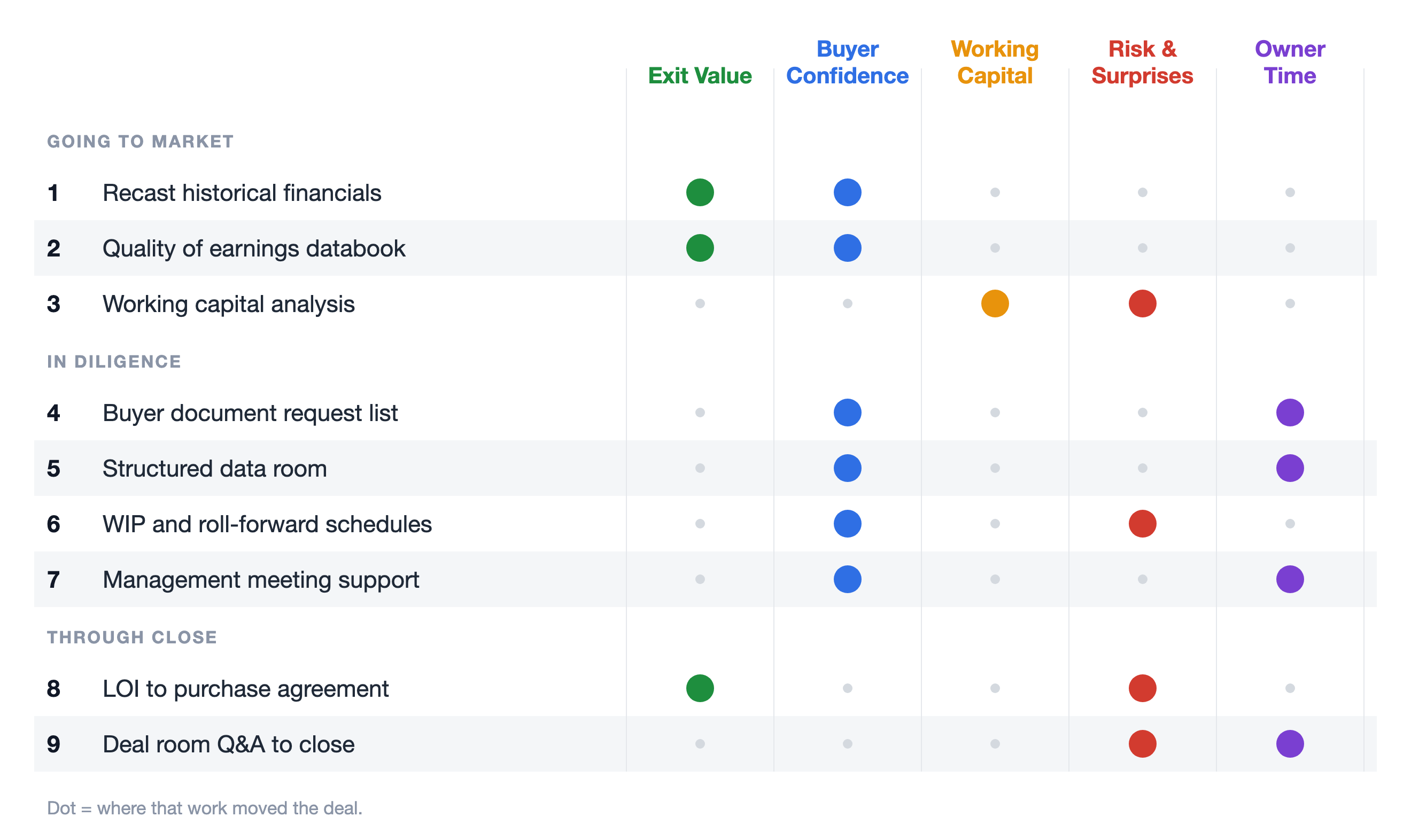
Nine workstreams make up the map, in the order a deal meets them. The map shows where each one moves the deal. The detail is below it.
Going to market
- 01
Recast historical financials
Buyers don't buy your tax return. I rebuild the historicals so owner comp, one-time costs, and personal expenses are adjusted out and the earning power of the business stands on its own, with every adjustment documented.
- 02
Quality of earnings databook
One workbook that holds the recast P&L, the adjustments, and the support behind each number. When the buyer's diligence team opens it, the answers are already organized the way they'll ask the questions.
- 03
Working capital analysis
The working capital peg is where sellers give money back without realizing it. I work out the real working capital rhythm of the business before the buyer proposes a number, so the peg gets negotiated from our math.
In diligence
- 04
Buyer document request list
Diligence opens with a request list that runs long. I own that list end to end so the owner can keep running the business instead of hunting files at midnight.
- 05
Structured data room
Every document indexed against the request list and complete before the buyer gets access. A clean data room reads as a well-run company, and buyers tend to pay more for one.
- 06
WIP and roll-forward schedules
The schedules that tie the balance sheet to the story: work in progress, receivables, debt, equity. These are the first places a diligence team looks for a crack between the story and the books.
- 07
Management meeting support
The owner tells the story, and I'm there to back up the numbers behind it. Prep before, financial answers during, follow-ups after, so nothing said in the room gets contradicted by the data room.
Through close
- 08
LOI to purchase agreement
Between the LOI and the purchase agreement the numbers keep moving: updated financials, schedule bring-downs, and the working capital math that feeds the final price.
- 09
Deal room Q&A to close
Diligence questions keep coming until the wire clears. I run the question log so answers stay fast, consistent, and final.
What I won't claim
I don't originate buyers and I don't negotiate your deal; your banker and your attorney do that, and the five closed deals I reference had good ones. I also won't attach sizes or multiples to those five transactions, because the confidentiality that protected those sellers protects you too. What I claim is the seat I actually sat in: the financials and the deal room, from first request to close, five times.
Straight answers
Questions owners ask
My bank is asking for a WIP schedule. Is that this?
Same discipline, and usually the next piece of work. WIP and roll-forward schedules tie what's on the balance sheet to what's actually happening in the field, whether a buyer is asking or your bank is. The Margin Map itself rebuilds your P&L and puts a 13-week cash forecast in your hands; if a lender letter is what brought you here, bring it to the call and I'll tell you exactly what a bank-ready package takes from there.
I already have a strong controller. What happens to them?
They get more valuable, not replaced. A good controller is the reason this work goes fast: they know where everything is, and they keep owning the books after I'm gone. I add the layer above: the close, the recast, the schedules, the buyer-facing math, and I build it so your controller can maintain it.
What does a sell-side CFO actually do?
Everything financial between deciding to sell and the wire clearing: recast financials, the quality of earnings databook, working capital analysis, the data room, and the diligence Q&A. The banker markets the company and negotiates. The attorneys paper it. The CFO seat makes sure the numbers hold up every time someone tests them.
When should exit preparation start?
Earlier than you think, and usually a year or more out. Recasting is fast; fixing what recasting exposes is not. Clean monthly closes, documented adjustments, and a defensible working capital rhythm take a few quarters to establish, and buyers pay more for a company that already has them.
What is a quality of earnings databook?
The workbook a buyer's diligence team uses to test your earnings: the recast P&L, every adjustment with its support, revenue detail, and the schedules that tie it all back to the balance sheet. Sellers who show up with their own don't have to live with the buyer's version of the truth.
Do I need this if I'm not selling for years?
The work that makes a company sellable is the same work that makes it more profitable to own: clean numbers, visible margin, and cash you can see forward. If a sale is a someday thing, that's the part worth starting now.
The engagement
What the Margin Map actually is
Three weeks, $7,500 flat, for owner-operated companies in the $5 to $50 million range. You get your P&L rebuilt by provider, location, or line, a 13-week cash forecast, and a ranked opportunity list with a dollar value and the math behind every item. If your books are already clean, the same three weeks get spent the way a buyer's diligence team would spend them: testing what you'd have to defend. I need read access to your books, three to four hours of your time across the three weeks, and a few hours from whoever runs the numbers today. If you have a controller or an office manager holding things together, they're an asset to this work, not its subject; I work through them, not around them, and the heavy data pulls get scheduled around your season, not on top of it. The Map either identifies at least three times its fee in margin opportunity, or you don't pay. Most owners keep me on to work the opportunity list; how that works is on the Margin Map page.
The first pass is the one a buyer would make
If a sale is anywhere on your horizon, the Margin Map runs the same first pass a buyer's quality-of-earnings team will run: rebuild the margins, test the schedules, find the gaps. The difference is that when I find them, they're your head start instead of their repricing argument.