A primary care practice's turnaround and exit
The owner was losing money every month, had no cash reserves, and was ready to walk away. This is the work that took the practice from monthly losses to a completed sale.
01 · Where it started
Where it started
A New England primary care practice losing money every month, with no cash cushion and an owner burned out enough to consider simply shutting the doors. The financials were in no shape to run the practice on, let alone to sell it. Owners in that spot are usually told the business can't be sold. This one could be, once the financials could carry weight.
02 · The work, mapped
The work, mapped to what it served
Five workstreams, in the order they landed. Big dot = that work materially served that outcome.
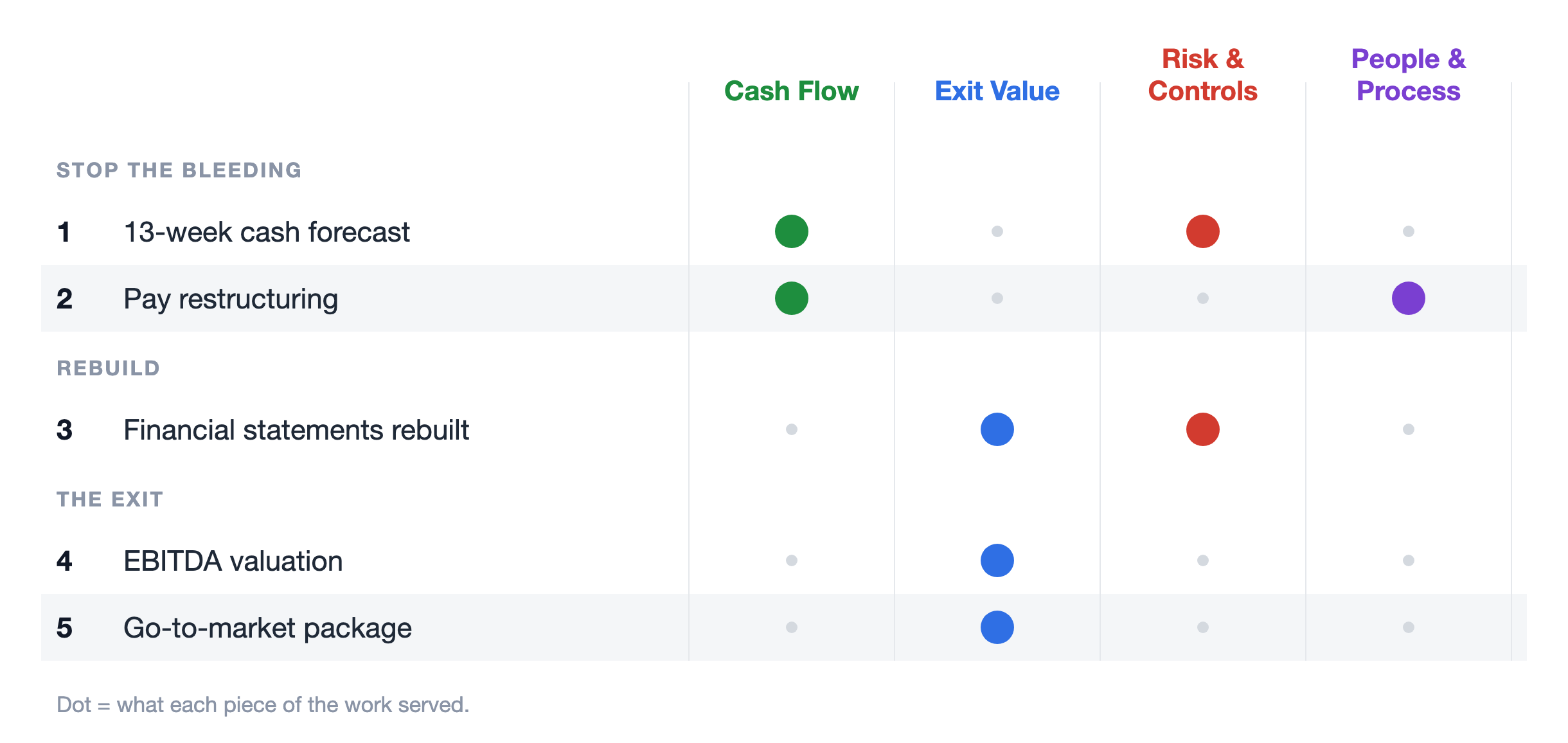
Stop the bleeding
- 01
13-week cash forecast
When there are no reserves, the first job is knowing exactly when cash gets tight and what moves it. The forecast gave the owner a clear week-by-week view of that, instead of a constant background worry.
- 02
Pay restructuring
Employee pay was renegotiated to stop the monthly losses. Calls like that belong to the owner, never to a consultant's spreadsheet; the work was giving the owner numbers solid enough to make them with, and to know when it was enough.
Rebuild
- 03
Financial statements rebuilt
The books were rebuilt into financials that could carry weight: running the practice week to week, and standing up to an outside reader later.
The exit
- 04
EBITDA valuation
With real financials in place, the practice got what it never had: a defensible number for what it was worth, and a clear view of what moved that number.
- 05
Go-to-market package
The valuation and the rebuilt financials became the package a buyer could evaluate. The practice went to market and sold.
04 · How it ended
How it ended
The practice sold. An owner who believed the business could never be sold because the financials were a mess, got a completed exit instead of a shutdown. I won't put a sale price or a multiple here; those belong to the seller. The part I'll point at is the order of operations: we fixed cash timing first, then rebuilt the books so they could carry weight, and the exit only became possible once those two were in place.
Straight answers
Questions owners ask
My practice loses money every month. Is it too late?
This practice was losing money with no reserves, and it ended in a sale rather than a shutdown. Late is real, but it's later than most owners think. The first two weeks of work are about cash timing, and that usually buys the room for everything else.
Do I have to be selling to start this?
No, and this owner wasn't planning to sell when the work started; they were planning to quit. Clean numbers keep both doors open: run it profitably, or sell it well. The work is the same either way.
What is a 13-week cash forecast?
A week-by-week view of cash in and cash out for the next quarter, updated weekly. It answers the question that keeps owners up at night, which is exactly when things get tight, early enough to do something about it.
The engagement
What the Margin Map actually is
Three weeks, $7,500 flat, for owner-operated companies in the $5 to $50 million range. You get your P&L rebuilt by provider, location, or line, a 13-week cash forecast, and a ranked opportunity list with a dollar value and the math behind every item. If your books are already clean, the same three weeks get spent the way a buyer's diligence team would spend them: testing what you'd have to defend. I need read access to your books, three to four hours of your time across the three weeks, and a few hours from whoever runs the numbers today. If you have a controller or an office manager holding things together, they're an asset to this work, not its subject; I work through them, not around them, and the heavy data pulls get scheduled around your season, not on top of it. The Map either identifies at least three times its fee in margin opportunity, or you don't pay. Most owners keep me on to work the opportunity list; how that works is on the Margin Map page.
Cash flow is the first thing we fix
The Margin Map starts with the same two moves that started this turnaround: a 13-week cash forecast and a P&L rebuilt to show what's really happening.